





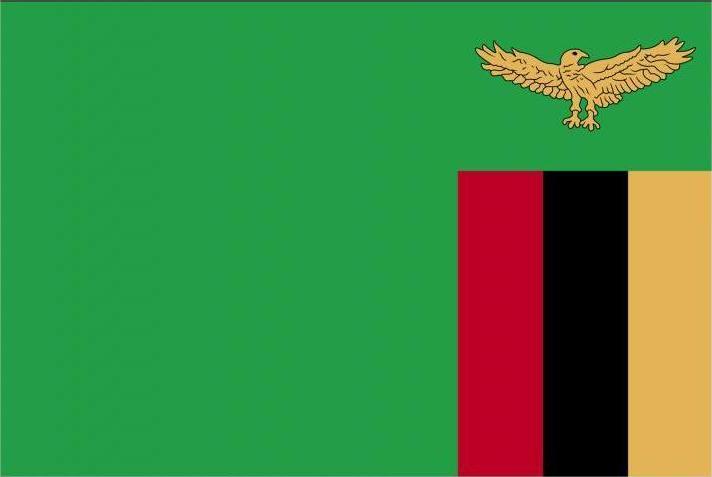
The Zambian government clarifies the use of Chinese currency in mining tax payments
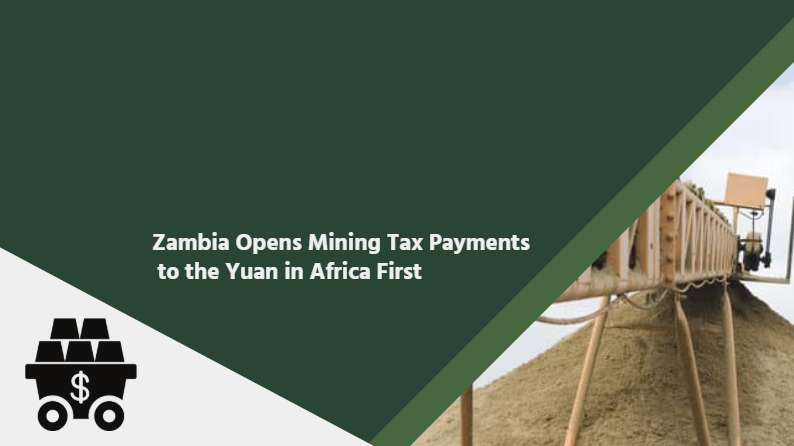
Government has clarified that the decision to allow the payment of some mining taxes in the Chinese currency, Renminbi also known as Yuan, is a strategic and cost-saving measure aimed at improving debt management and reducing foreign exchange conversion costs.
Minister of Finance and National Planning, Situmbeko Musokotwane, says the measure should not be interpreted as a shift away from the Zambian Kwacha, which remains the primary legal tender for domestic transactions.
Speaking during a media briefing in Lusaka, Dr Musokotwane said the clarification was necessary following widespread public and regional interest after reports emerged that Zambia had begun collecting mining taxes in Renminbi.
The Minister explained that taxes in Zambia are ordinarily payable in Kwacha, but the government may, from time to time, designate other currencies for specific sectors for macroeconomic stability reasons.
He cited the 2018 decision, later expanded in 2020, which required mining companies to pay certain taxes in United States Dollars.
Dr Musokotwane said the same strategic logic now applies to the limited use of the Renminbi.
He further disclosed that in 2025, about 75 percent of mining taxes were paid in USD, approximately 25 percent in Kwacha, and about 2 percent in Renminbi.
Dr Musokotwane added that looking ahead to 2026, the government expects around 60 percent of mining taxes to be paid in USD, about 25 percent in Kwacha, and approximately 15 percent in Renminbi.
The Minister stressed that China remains Zambia’s largest bilateral creditor and that most loans contracted from China were denominated in Renminbi and not USD.
“When it is time to service that debt, repayment is required in the same currency that was borrowed. Allowing a portion of taxes to be paid in Renminbi enables the government to avoid unnecessary conversion costs,” Dr Musokotwane said.
He noted that converting USD into Renminbi attracts transaction costs and settlement delays, which the government seeks to minimise through this approach.
The Minister emphasised that the arrangement is limited and targeted, currently applying to a small number of mining companies with strong links to China, and does not compel all mining firms to pay taxes in Renminbi.
“This does not mean that every mining company is being forced to pay taxes in Renminbi. That is not the case,” he clarified.
Dr Musokotwane further assured the public that the policy would have little to no direct impact on ordinary citizens.
“For the common person, there will be no noticeable change. The benefit is that the government saves money, and those savings can be redirected toward public services such as health, education, and social support,” he said.
Meanwhile, the Minister explained that the Renminbi already forms part of Zambia’s foreign reserves, noting that the currency is included in the International Monetary Fund’s Special Drawing Rights (SDR) basket.
He added that reserve management always involves balancing risks, stressing that no currency or asset is completely risk-free.
On monetary policy, Dr Musokotwane said domestic transactions will continue to be settled in Kwacha and that the policy does not undermine the effectiveness of Zambia’s monetary framework.
“This measure does not represent a shift in monetary policy. It simply helps to ease pressure on the foreign exchange market by reducing over-reliance on a single foreign currency,” he said.
And speaking at the same briefing, Bank of Zambia Governor, Denny Kalyalya added that the move also strengthens the stability of the monetary system.
Dr Kalyalya explained that holding Renminbi as part of Zambia’s foreign reserves helps balance pressures in the currency market.
“Having multiple foreign currencies available reduces over-reliance on the USD and other single currencies. It gives the Bank more flexibility to manage liquidity and stabilise exchange rates,” Dr Kalyalya said.
He further clarified that domestic monetary policy remains fully effective because local transactions continue to be settled in Kwacha.
Dr Kalyalya also highlighted that all foreign assets, including reserves, carry some level of risk, and that the Bank continuously monitors these risks to safeguard economic stability.
Meanwhile, Dr Musokotwane concluded by thanking officials from the Ministry of Finance, the Bank of Zambia, and the Zambia Revenue Authority (ZRA) for their role in ensuring prudent economic management.
He reaffirmed that the government would continue engaging stakeholders as circumstances evolve.

































First, please LoginComment After ~